Firstborn

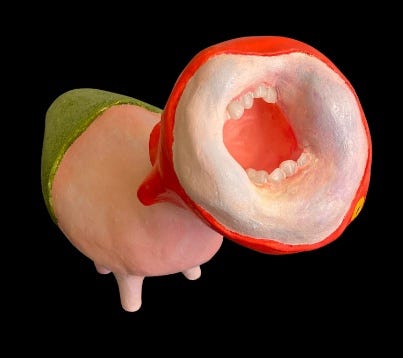
Note: This is a story I wrote several years ago. Not sure what I think about it, but then I feel that way about most of the stuff I write. Oh, and I’ve thrown in a pic of my latest sculpture. —J
He introduced me as his sister, as if that’s all I was. A random accident of birth, a point on one of those family trees. She wasn’t what I expected. Her skin was perfect and her smile was cutely lopsided. She stood in front of the kitchen sink, the late morning light evenly spread across her delicate face. She handed me a tin of snickerdoodles, my favorite cookie. That meant they had talked about me. I put the tin on the counter and the kettle on the stove. We moved from the kitchen to the dining room. When the kettle whistled, I poured three cups and set theirs down first. I came back with mine and she asked for a cookie. Jack jumped up and said, “I’ll get it.” When he placed the tin on the table, she pried open the top eagerly and took out two cookies. She chewed deliberately. I saw a disdain for me in the grinding of her jaw.
“Jack tells me you’re thinking of selling this place,” she said, sweeping her eyes around the room, her mouth full.
“Maybe, eventually ….” he answered before I could say anything.
“We’re thinking of downsizing. It’s a lot of room for the two of us, especially now that I’m not working and Jack is … well … he never started,” I said. I smiled and looked at him. He stared down at his hands.
“You don’t consider making art work?” she asked and narrowed her eyes.
I was honestly confused for a minute. I had never thought of the made-up animals Jack crafted out of scraps of wood and stuff he found at the dump to be art. It was a hobby, something to keep him busy.
She asked again if I didn’t consider making art work.
“Well, I can’t send a bee with horns and a split tongue to the bank to cover the mortgage, can I?”
She laughed and took another bite of her cookie.
“I guess craft projects become art when the maker is 42-years-old,” I said.
Jack’s face turned red. She rubbed the back of his neck. From the beginning, I was the one who encouraged Jack to be creative. I gave him rocks and sticks and bits of moss to put together when we hid in the woods for the first few days. I called him “Jack” because he loved the jackrabbits that sprinted off in the distance, and because, like all the firstborn boys, he hadn’t been given a name.
She looked around the room again and said, “You probably could use a smaller place. It’s too big for two and would be even more so for one.”
We sipped our tea in silence for a while. When they were ready to go, she slid the lid back on the tin of cookies and said, “Since you’re not interested.” She headed out with the tin in one hand and Jack’s hand in the other. I watched her car move out of the driveway. They had one of Jack’s sculptures crammed into the hatchback and a creature with breasts, an elephant’s trunk and antlers made of wood and scrap metal stared back at me as the they disappeared down the road.
I went into Jack’s room. He had installed a padlock on the door, but I found a spare key in one of his socks when I was doing laundry. The picture of Gran H that was usually on his nightstand was missing and I searched around for it. I found it face down in his underwear drawer. Gran H was the grandmother I’d made up for him, and when I found a picture of an old woman in a pile of photos in a thrift store, I knew she was the right one. Doughy face, watery eyes. Gran H was loving and took care of us when our parents died in that terrible car accident on a rainy night. Hydroplaned, I told Jack. In a tan Audi 100 that I claimed I remembered riding in. Then one day Gran H died. A massive heart attack that left her sprawled on the kitchen linoleum. I became everything for him then, or at least way more than a mere sister.
I put the picture back on Jack’s nightstand and traced my finger around the silhouette of Gran H, a woman long dead, whose picture no one wanted to keep. A woman who maybe wasn’t even a grandmother.
I had saved Jack twice: once literally and once from the truth. Because our real grandmother was no Gran H. “Finally, a boy after this glut of girls,” she had said when he was born, and we all knew what she meant. Mom and Dad were relieved because for them a boy meant they didn’t have to have more kids, and all the suspicion about our branch of the family only having girls would fade. I was sixteen, old enough to help with the delivery, and I was the first one to see his blood-smeared head push through the cleft between my mother’s legs.
Jack didn’t come home until the next day, and he found me asleep in his bed. I woke when he sat down next to me. He opened his wallet and took out two crisp $100 bills. “I sold a piece. Well, actually Brit sold it for me,” he said.
I was quiet for a few seconds and then said, “Congratulations.”
“I want to start contributing something to the house—as long as I’m here.”
“As long as you’re here?”
He looked down and stayed quiet.
I got out of bed and started walking out of the room.
Jack followed me with the two hundred dollars.
“Take this,” he said.
“Don’t need it.”
I closed the door behind me, leaving him on the other side with the money hanging out of his fist like a green tongue.
I didn’t need it. After saving Jack, making money became my primary goal. Money was both concrete and magical. I remember hearing in one of Granfather’s sermons about how it was the root of all evil and even then—especially coming from him—I thought that was ridiculous. Money could be used to communicate all sorts of things and it offered protection and control and freedom. And it did it all without bloodshed. I loved how it smelled of ink and age. The more money you had the more magic you had—and no one had to be sacrificed. Grandfather: It’s the lack of money that’s at the root of all evil.
After that first time, Jack kept giving me money. A hundred dollars slipped under my bedroom door; three-hundred and fifty dollars left in an envelope on the kitchen table; seventy-five dollars in paperclip on my dresser. I knew it was coming when I’d peek into his shed in the backyard where he made his ridiculous creatures and find an empty space where one had stood or the table he worked at was suddenly cleared of his latest project. I stopped trying to give it back, but I didn’t spend it either.
* * *
I didn’t see her for a few weeks after we met that first time, but I knew Jack did. He’d leave without saying goodbye and come home at odd hours. It was the middle of summer and once I caught him coming home at night through an open window, thinking he wouldn’t wake me. He touched his finger to his lips and said “Shhhh,” as if I weren’t already awake and standing in front of him. I realized only later that he was telling me to be quiet.
The next time I saw her I was mowing the backyard lawn, making perfect strips of shorn grass. I wore a halter top that showed my sagging skin and unshaved armpits. I had stopped caring about how I looked at around the same time as the mothers I knew did and this was no coincidence.
When I reached the shed, the door was open. The smell of smoldering metal drifted out of it. A brochure with pictures of Jack’s sculptures lay on a table, and a fan fluttered its pages. They were there, in the middle of the room, locked in a kiss, him enveloping her tiny frame and she with her hands gripped on his sides. The lawnmower still roared, but neither of them moved. Jack’s hair was now sun-bleached to the blonde it was when he was boy. For years after we had fled a vision chased me. The top of nameless Jack’s head the only part of him not submerged in the Lake of the Lamb, a little white circle of hair like a rheumy eye. Our grandmother’s knotty fingers pressed down his shoulders until the circle of head disappeared below the water and grandmother trudged out of the lake, her wet dress limp around her.
A stab of the fear—the kind I hadn’t felt in years—cut through me. Without even thinking about it, I lightly touched Jack’s head. He swung around, stunned
“What are you doing?” he shouted loud enough so that I heard it clearly over the grinding of the lawn mower.
“What the fuck?” she shouted. There was more disgust than anger in her face.
I stood there, frozen. Everything I thought to say died in me before I could utter it.
His face demanded an explanation. Hers telegraphed that there could be none.
“I—I—,” I said, dumbly.
“Can you just leave us alone? Go do … something with yourself and let your brother have—”
Jack held up his hand and she stopped talking.
“Just go back to mowing the lawn. We can talk later, but Brit and I—we’ll talk later.”
Jack’s voice had a seriousness and certainty to it that I’d never heard in it before.
She moved first, grabbing Jack around the waist and turning him to her. She stood on her tiptoes and he immediately bent down so his lips could meet hers. She pulled him closer. He pressed his hips into her. She twisted her leg around his. They melted into each other. I grabbed hold of the idling lawn mower and stomped a straight line across the strips I had made earlier to the house. I went back and forth in the opposite direction I had initially mowed in. By the time I had covered the lawn again I decided that Jack needed to know the truth. I had saved him once for himself and now I would save him for me, and I’d do it by telling him everything.
I went inside and flung open the dresser drawer where I had kept the money Jack gave me. It was now around a thousand dollars. A joke, really, that he saw this as contributing. He was a child, and if it were up the Church of the Final Holy Redeemer he would have remained one.
I spread out the money, mostly twenties, on my desk, grabbed a pen, and started writing. I told Jack about how the whole thing had started in that first year when our grandparents and their small group of followers settled on the stubbly land no one wanted right in the middle of the country. They barely scraped by, and some of the congregation left within a couple of months. Then our great-uncle drowned in a stream by the church they had built. Grandmother found him, face down. She pulled his stiff two-year-old body out of the water and brought him home to bed, praying that he would come back to life for five days. She would have continued, but grandfather wrapped him in his bedsheet and buried him in the plot of land that would become our cemetery.
After that, the community stabilized and eventually prospered. Its numbers multiplied. Grandmother was convinced that this was only because of the death of her firstborn son and she demanded that each family make their sacrifice. With some of the other men, grandfather dug out the Lake of the Lamb and Grandmother decreed that grandmothers would act as executioners. “Mothers would be too squeamish and fathers could never really understand the depth of the sacrifice,” she had said. We were all to pray for five days afterward, as she did. This would come to an end when one day the prayers would work and a two-year-old would rise up, dry and clean, from the Lake of the Lamb. “That’s when we’ll all go home again,” Grandmother promised.
I wrote in a feverish scrawl on both sides of the bills, telling Jack everything. I wrote about our parents and the doubt I sometimes saw in them. I told him about the fights between them and Grandmother, whose other children had all produced the required son while they kept making girls, even as Mom edged toward her mid-forties. I even told him about how I named him because none of the firstborn boys got names. They belonged to God—not us—and for us to name them was to claim what wasn’t ours. When I was done, I put the bills into an envelope, sealed it, and wrote “For Jack ONLY” on the outside. I went to his room, and put the envelope under the picture of Gran H. Then I got in my car and drove around for a while. When I got back Brit’s car was gone and the house was empty. I checked Jack’s room and saw that the envelope wasn’t there. His closet door was open and most of clothes were gone, even the parka he wore in wore in winter.
* * *
I waited after that. Waiting, for the first time, seemed like an activity to me. Not anxious time to be distracted from, but a project in itself. I let everything go because I was waiting. Time was liminal and blank. I lived in an open-ended pause. The garbage piled up. When the fall came the leaves moldered on the ground and smelled of rot. I stopped doing laundry. I only left the house to buy food.
Once after I had gone grocery shopping, I went into the shed and found that all of Jack’s tools were gone. Still, I await his return. I know that he’ll come back one day and we’ll resume our life together. I won’t ask questions, especially not at first. I’ll let Jack come to me in his own time and one day, while we’re eating dinner or planting something in the garden or watching a movie, he’ll tell me, in a soft, supplicating voice, that he never squandered the money on her.
Excellent story. And some of your sentences (e.g., "I saw a disdain for me in the grinding of her jaw") are masterful.